Never overheat your home again
Four steps to a heat-resistant home thanks to the ‘Ladder of Cooling’
Recent studies agree: as climate warming continues, more and more existing homes will suffer from overheating inside. In addition to rising cooling costs, this also has a major impact on occupant comfort and health. That’s why those who are building or renovating must address the issue of overheating today. The ‘Ladder of Cooling’ helps you do this in four steps towards a sustainable and future-proof home.
If you’re going through those steps on the ‘Ladder’ – introduced by the Dutch OSKA (Overleg Standaarden Klimaatadaptatie/Climate Adaptation Platform Netherlands*) – in the right order as a renovator/builder, then your new or renovated home won’t even have a chance to overheat. Plus, cooling in summer will work just as sustainably and energy-efficiently as heating in winter. Active cooling (air conditioning) is deliberately considered a last resort in this regard because you don’t need to cool down the heat if it can’t get in.
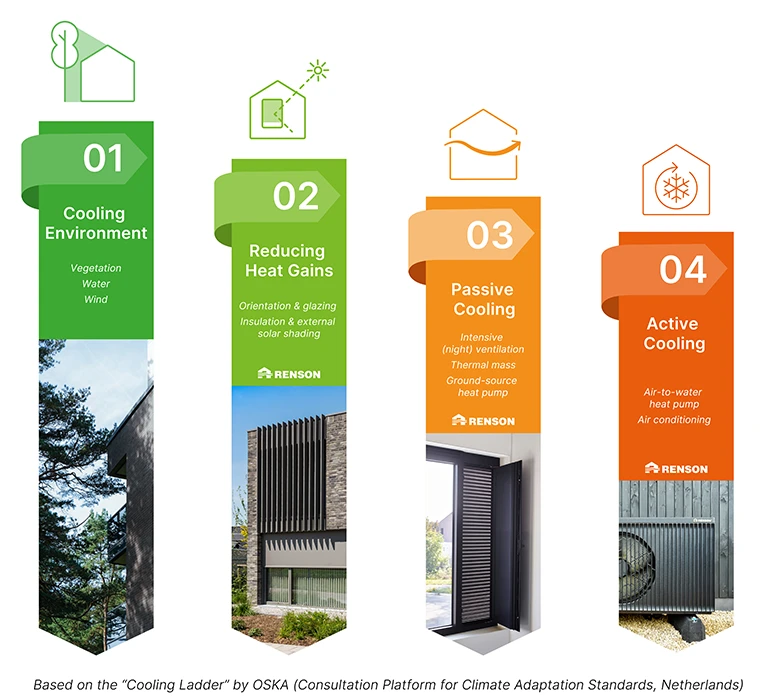
1. Provide a cool environment, with water and landscaping
Keeping your home cool on hot days starts with the immediate environment. Green (trees and plants) and blue (water) indirectly contribute to a pleasant indoor climate. A strategically placed tree provides much-needed shade. And both plants and water features extract heat from the environment via evaporation, providing an additional cooling effect.
2. Keep the heat out
If you know that heat gets in most easily through the windows, it is best to start by preventing the sunrays from reaching the glass and raising the temperature inside. How, you ask? With a tree in the right place, overhangs, or with outdoor sun protection, such as screens, structural sun protection overhead, or sliding panels in front of the window. That way, your interior doesn’t heat up as quickly. What’s the advantage of screens? In summer, they keep the heat out (when lowered), but if you pull them up in winter and in between seasons, you still maximise the free solar heat at that time.
3. Passive cooling!
Has the heat still managed to seep inside? Then the first solution is to combat it with passive techniques, such as night cooling in the form of burglar-proof and insect-proof louvres recessed into the windows. Then cooler outside air naturally ‘flushes’ the house at night so that by the next morning, the thermal mass of the building has lowered the thermometer by several degrees.
You can also use a geothermal heat pump to cool your home. The unit then deploys the coolness from underground to cool your living spaces via the underfloor heating ducts. Please be aware that the cooling capacity of such a heat pump is limited. If you can’t manage to keep out the heat sufficiently, then this solution will not work wonders.
4. Active cooling as a last resort
Active cooling is still sometimes appropriate in cases of extreme heat or prolonged hot periods – especially if there is little cooling at night. An air conditioner or a heat pump can therefore be useful, but only as a last resort to deal with peaks. If you’ve worked your way up the previous steps of the ‘Ladder of Cooling’, then you’ll never have to face a sky-high energy invoice again. Moreover, because of the extra CO2 emissions, active cooling – if not powered by renewable energy – just further contributes to global warming.
More tips from experts to get ahead of overheating? Read the full expert report here.